Traffic alerts that don't cry wolf
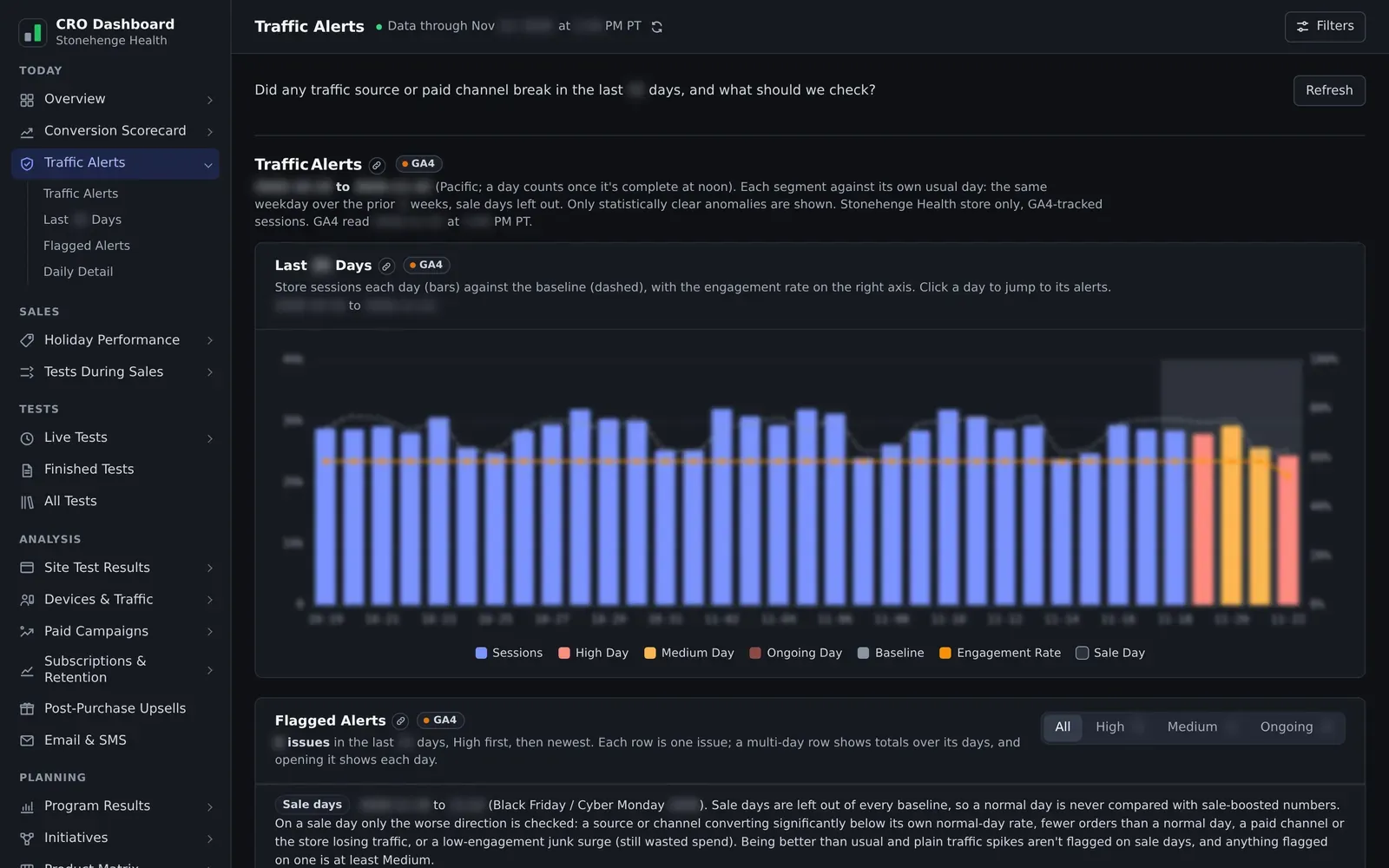
Broken links, mislabeled campaigns, and junk ad surges were getting found days late, and noisy alerts get muted. I built anomaly detection that only speaks up when the statistics say something is really wrong.
- Role
- Self-initiated · statistics, design, and build
- When
- Nov 2026
The problem
When a campaign points at the wrong URL, a landing page breaks, or an ad starts buying junk clicks, the money burns quietly. Ad platforms have their own safeguards, but they don’t know what a normal Tuesday looks like on our store. The obvious fix, an alert for every dip, fails the other way: after a week of false alarms, nobody reads them.
The approach
- Compare like with like. Each traffic segment (channel, source, campaign, landing page) is compared with its own usual day: the same weekday over prior weeks, with sale days and its own past surge days left out of the baseline. No borrowed site-wide rates.
- Test, then correct for testing a lot. Counts get Poisson and day-to-day-spread tests. Because hundreds of segments are checked every day, every result goes through Benjamini-Hochberg false-discovery control, and severity tiers need both a tight q-value and a large effect.
- Say what it costs. A surge of sessions that don’t convert is framed as wasted spend. “Fewer orders” only fires when purchases fall well below a normal day, and conversion isn’t judged at all until a segment has enough history to mean something.
- Respect sales. On sale days only the worse direction is checked, and anything flagged is at least Medium, because a sale is exactly when breakage costs most.
- Close the loop. A naming check flags paid campaigns whose traffic lands on pages with no product, then tracks the issue as ongoing instead of re-alerting every day. One daily digest goes out after the day is complete.
The outcome
- Alerts fire only on high-confidence problems, so they get read.
- Thresholds were tuned against real traffic, including a junk-surge bar set from actual non-converting spikes.
- It lives inside the CRO Dashboard, so every flagged day links straight to the segment, its baseline, and the math behind the call.
Stack
GA4 Data API reads behind a serverless function, Poisson and dispersion tests, Benjamini-Hochberg q-values, a scheduled daily digest, and the CRO Dashboard UI.
Full stack
- Poisson tests
- Benjamini-Hochberg FDR
- GA4 Data API
- Vercel cron
- CRO Dashboard